
When You’re Not Sure What You Need: Counselling, Coaching or Both?
Supporting Mental Health & Wellbeing Through an Integrated Approach
When we reach a point in life where we seek support for our mental health and wellbeing, one of the first questions we often ask is:
“What kind of support do I actually need?”
“Do I need Counselling? Coaching? Therapy? Or something else entirely?”
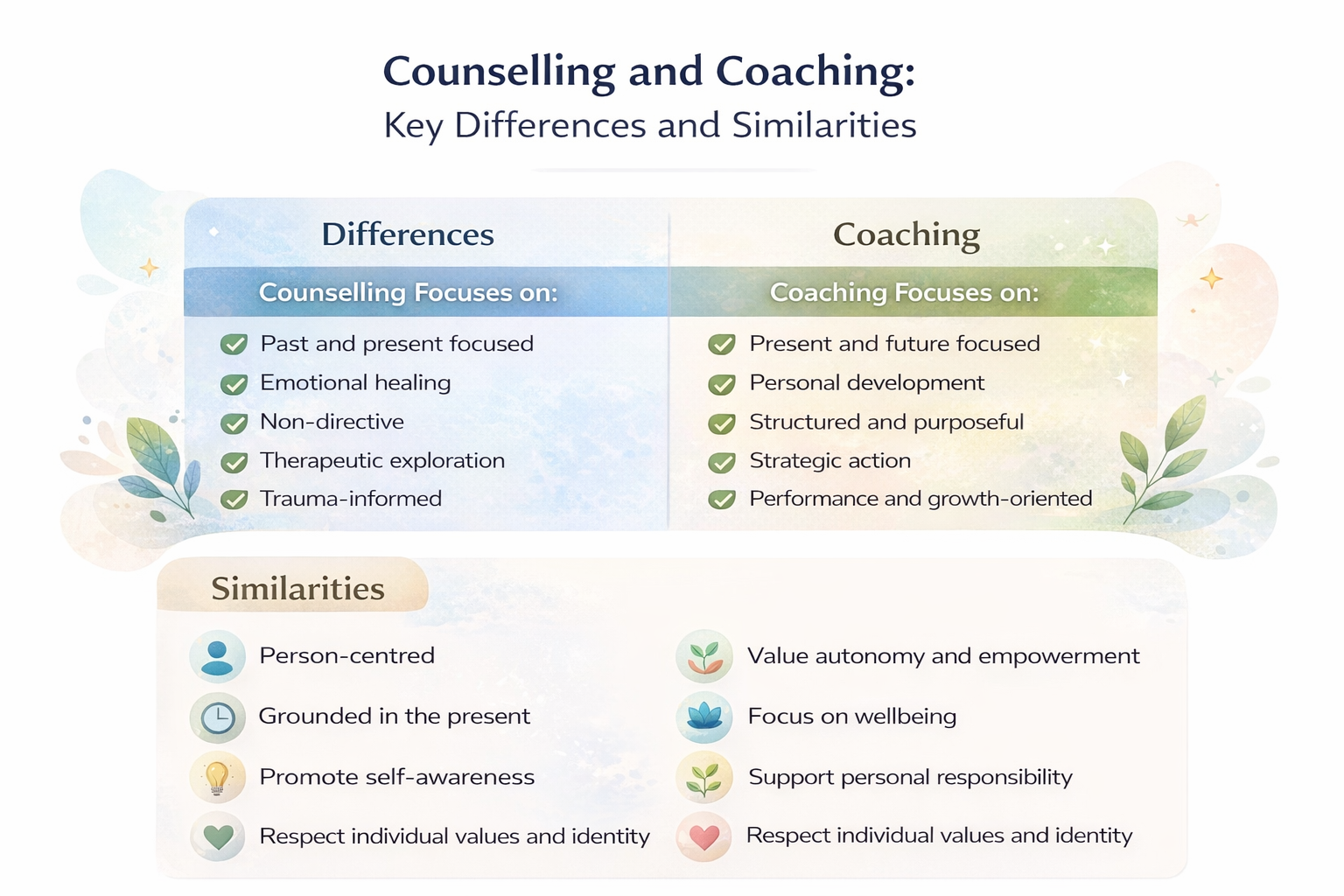
Counselling and Coaching are often seen as quite different approaches, and in many ways, they are. Traditionally, counselling is associated with healing, emotional processing, and understanding the past, while coaching is linked to motivation, goal-setting, and creating a better future. However, these differences are not limitations - they are strengths.
In practice, counselling and coaching can work powerfully together. When integrated ethically and intentionally, they form a holistic, person-centred approach and integrate well together in therapy, where emotional healing, self-awareness, personal growth, and future development are not separated, but woven together.
As a practitioner working across counselling, mental health, and wellbeing coaching, I have seen how these two modalities naturally integrate. This article explores their differences, similarities, and how they combine to support clients in a balanced, personalised, and empowering way.
What is Counselling?
Counselling is grounded in the belief that every individual has an innate capacity for healing, growth, and change. Central to many counselling approaches, particularly person-centred therapy, is the understanding that the client is the expert in their own life.
Because of this, counselling is often non-directive. A counsellor does not tell you what to do or who to be. Instead, they offer a safe, compassionate, and non-judgemental space where you can explore your experiences, emotions, beliefs, and relationships at your own pace. Counselling focuses on:
Emotional processing
Trauma and past experiences
Relationship patterns
Identity and self-concept
Attachment and loss
Mental and emotional distress
It provides a secure environment built on empathy, trust, and acceptance, allowing clients to make sense of how past experiences influence present-day thoughts, feelings, and behaviours.
Analogy:
In counselling, the client is in the driver’s seat, and the counsellor is the passenger. The client controls the direction and pace. The counsellor helps by noticing what the client may not see clearly, offering reflection, insight, and new perspectives.
What is Coaching?
Mental Health and Wellbeing Coaching is future-focused, proactive, and collaborative. Coaching supports clients in building the life they want, based on their values, strengths, purpose, and aspirations. Coaching focuses on:
Goal setting and planning
Behaviour change
Confidence-building
Motivation and accountability
Strength-based development
Resilience and self-efficacy
Coaching encourages clients to think expansively:
“What does my best life look like?”
“What do I want to move towards?”
“Who do I want to become?”
It is structured, action-oriented, and empowering. Coaches collaborate with clients to develop strategies, skills, and pathways for achieving wellbeing, balance, and fulfilment.
Analogy:
In coaching, the client chooses the destination. The coach becomes the navigator, helping plan the route, identify obstacles, build resources and strategies, and stay focused on the journey.
Integrative Therapy: Where Counselling and Coaching Meet
This is where integration creates real transformation.
Although counselling and coaching appear to operate at opposite ends of a timeline (past vs future), both are deeply rooted in the present moment. Our mental health struggles, emotional distress, and wellbeing challenges are always experienced now. An integrative approach recognises that:
We are shaped by the past.
We live in the present.
We move towards the future.
Rather than separating these dimensions, integrative therapy works across all three.
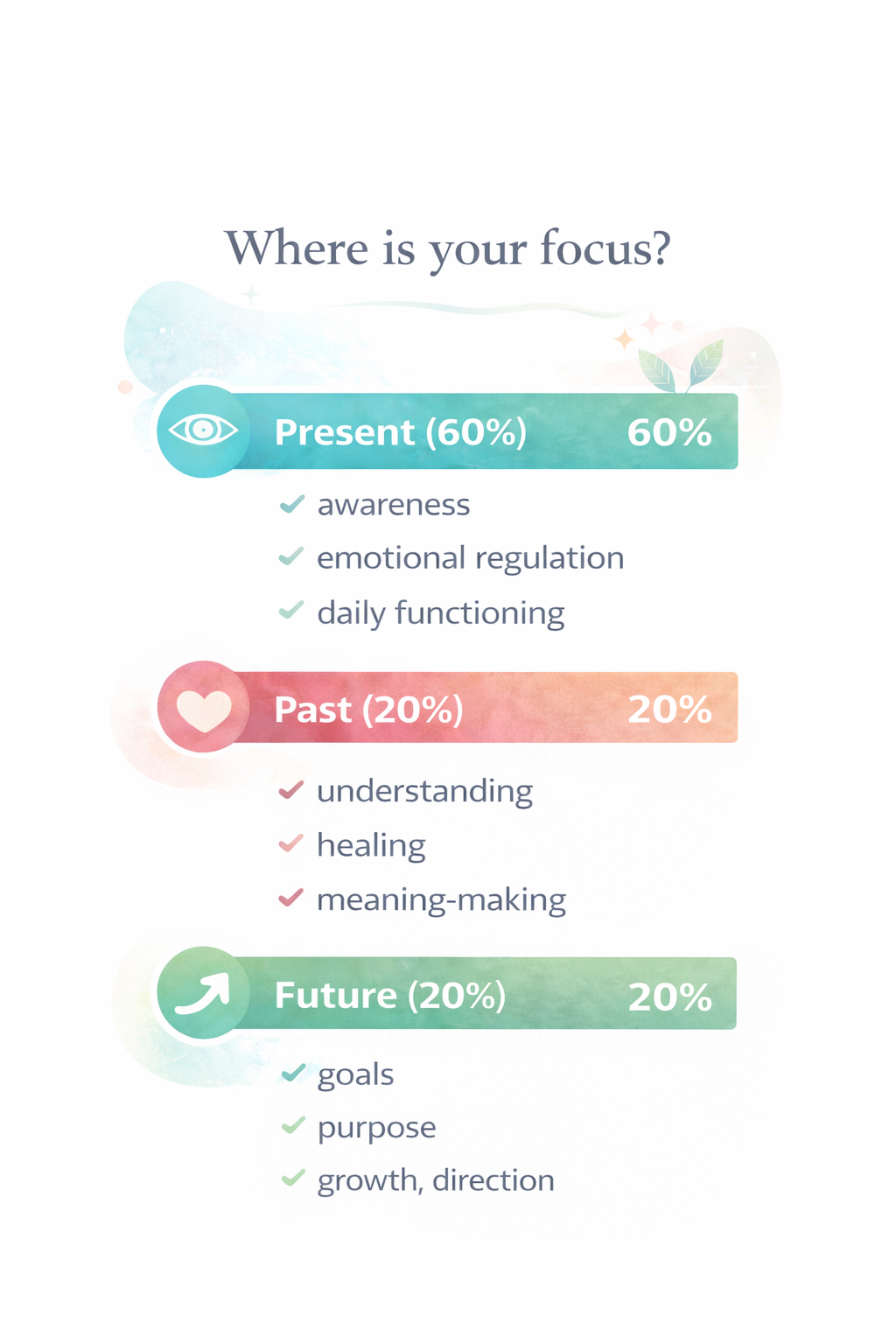
Balanced Focus:
This image is a representation of our ideal Focus Model.
But life rarely works this neatly.
Trauma can pull us into the past.
Anxiety can trap us in the future.
And burnout can disconnect us from the present.
Examples of How Integration Works in Practice
Example 1: Anxiety and Confidence
A client presents with anxiety and low self-confidence.
Counselling work: explores early experiences of criticism, shame, and fear of failure.
Coaching work: builds confidence skills, boundary-setting, and future goals.
Integrated outcome: emotional healing + empowered action
Example 2: Burnout and Identity Loss
A client experiencing burnout feels disconnected from themselves.
Counselling work: processes grief, loss of identity, and emotional exhaustion
Coaching work: rebuilds purpose, meaning, values, and life direction.
Integrated outcome: recovery + renewal
Example 3: Trauma and Life Direction
A client has unresolved trauma but also feels stuck in life.
Counselling work: trauma-informed safety, emotional regulation, inner child healing
Coaching work: rebuilding agency, confidence, and future planning
Integrated outcome: safety + growth
Why Integrative Therapy Works
Integrative therapy recognises that people are not linear; healing is not separate from growth and growth is not separate from our sense of who we are.
The past, present, and future are not separate experiences, rather they are psychologically interconnected.
By integrating counselling and coaching, clients are supported to:
Heal without becoming stuck.
Grow without bypassing pain.
Plan without ignoring emotional needs.
Move forward without abandoning the past.
Conclusion
Counselling, coaching, and integrative therapy are not competing approaches, they are complementary. Counselling offers depth, safety, emotional healing, and understanding, whereas coaching offers direction, empowerment, structure, and future-building.
Integrative therapy brings them together.
It creates a full-spectrum model of mental health and wellbeing support, where clients are seen as whole people, not problems to fix.
Through integration, clients learn to understand their past without being trapped in it, live fully in the present and build their future with intention and confidence.
As the saying goes - opposites attract. Counselling and coaching differ in pace, structure, and focus, but they share the same foundation:
A deep respect for the individual, belief in human potential, and commitment to self-empowerment.
If you're curious about whether counselling, coaching, or an integrative approach might be right for you, you’re welcome to get in touch to find out more.
