
Are You Constantly Ask Yourself: “Why Am I Like This?”
From Self-Judgment to Self-Compassion: How to Change Your Inner Dialogue
It might start with something small.
You notice a mistake you made during the day, or you feel anxious about something that hasn’t even happened yet. Your mind begins to race, and before long you’re asking yourself the same familiar question:
“Why am I like this?”
Then another thought appears.
“Why can’t I control my thoughts?”
“Why do I always imagine the worst?”
“Why does everyone else seem to cope better than me?”
What began as a moment of worry quickly turns into a stream of self-judgement.
If this feels familiar, you’re not alone. Many people experience this pattern of negative self-talk, especially when they’re feeling anxious or overwhelmed.
The way we speak to ourselves internally has a powerful influence on how we feel. Learning to gently change that internal dialogue can reduce anxiety, soften self-judgment, and help us respond to difficult thoughts with greater patience and self-compassion.
“Why Do I Feel So Hard on Myself?”
Many people are far more critical of themselves than they would ever be toward someone else.
When something feels wrong internally, such as anxiety, worry, or self-doubt, the mind naturally tries to understand it. But when we’re already feeling vulnerable, those attempts at understanding can easily become self-criticism. You might notice thoughts such as:
“I should be able to control this.”
“Other people don’t seem to struggle like this.”
“Something must be wrong with me.”
Over time, this pattern of self-judgement can become automatic. Instead of responding to our emotions with curiosity or care, we respond with interrogation.
And one of the most common forms that interrogation takes is the repeated question:
“Why?”
The “Why Loop”
When our minds repeatedly ask these questions during moments of distress, we can become stuck in what might be called the:
“Why Loop.”
The why loop happens when the mind keeps searching for explanations for uncomfortable feelings but never arrives at a helpful answer.
It can look something like this:
You feel anxious,
You ask yourself “why”,
Your brain searches for explanations,
Those explanations often become self-critical and judgmental,
Your anxiety increases,
You ask “why “ again.
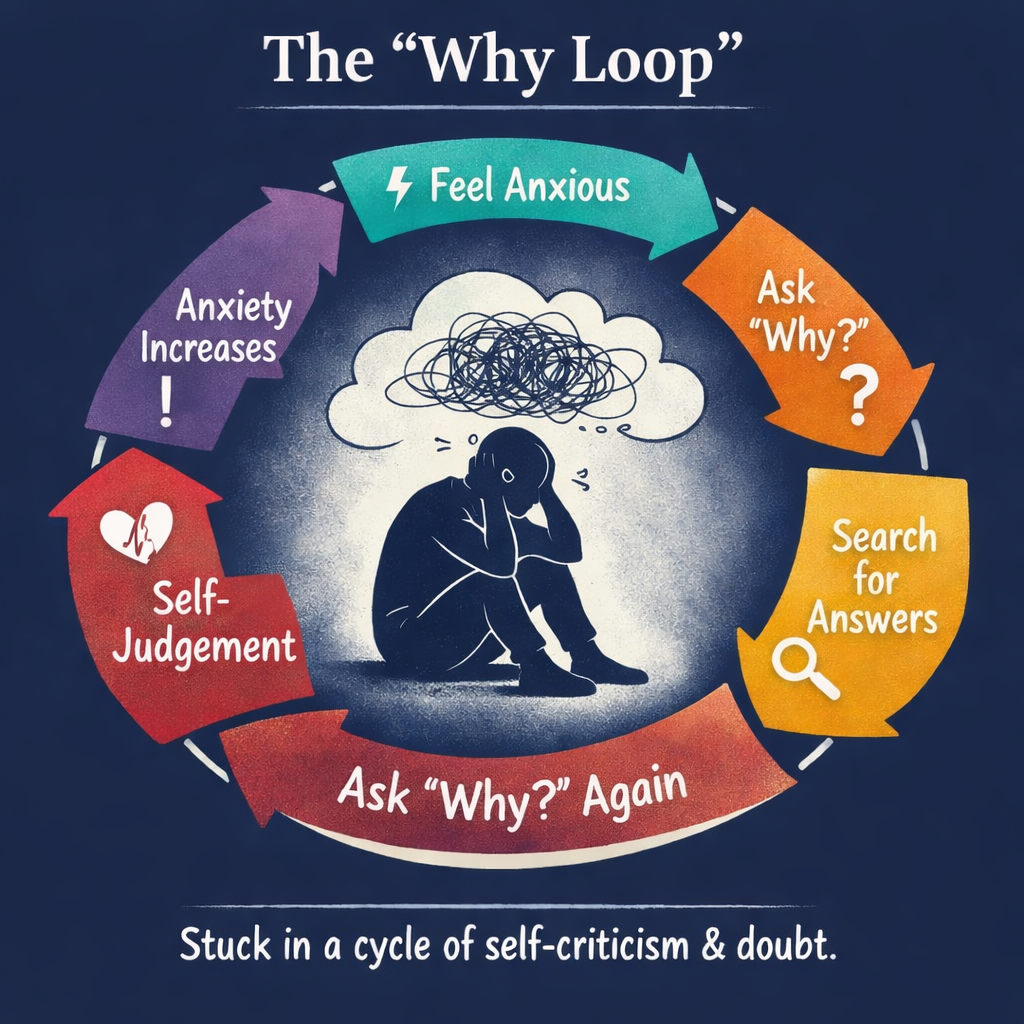
The cycle repeats.
Instead of creating understanding, the mind becomes caught in a loop of questioning, self-criticism, doubt and self-judgment. This can leave you feeling even more overwhelmed and frustrated with yourself.
Why “Why” Questions Can Make Anxiety Worse
When anxiety appears, it’s natural to want to understand it. But repeatedly asking “why” questions can keep the mind circling the problem rather than moving through it.
When the nervous system is already activated by anxiety, the brain tends to search for quick explanations rather than accurate ones. These explanations may sound like:
“Because you're weak.”
“Because you can't cope like other people.”
“Because something is wrong with you.”
Of course, these are not objective truths. They are simply the anxious mind trying to make sense of discomfort.
But hearing these thoughts internally can deepen feelings of shame, frustration, and helplessness.
This is one of the reasons the Why Loop can feel so exhausting; it keeps us focused on blame instead of support.
“Why Do I Overthink Everything?”
Overthinking is closely linked to anxiety. When the brain senses uncertainty or potential danger, it tries to solve the problem by analysing it repeatedly.
Unfortunately, the mind often confuses thinking more with thinking better.
Instead of resolving the feeling, the brain becomes trapped in a loop of:
analysing
predicting
imagining worst-case scenarios
This is why anxious thoughts often return to the same questions again and again.
Breaking this cycle doesn’t always require solving the thought itself. Often, what helps most is changing how we respond to the thought.
A Small Change That Can Shift Your Inner Dialogue
One helpful technique is surprisingly simple - reframe the questions:
Replace “Why” with “What” and “How” .
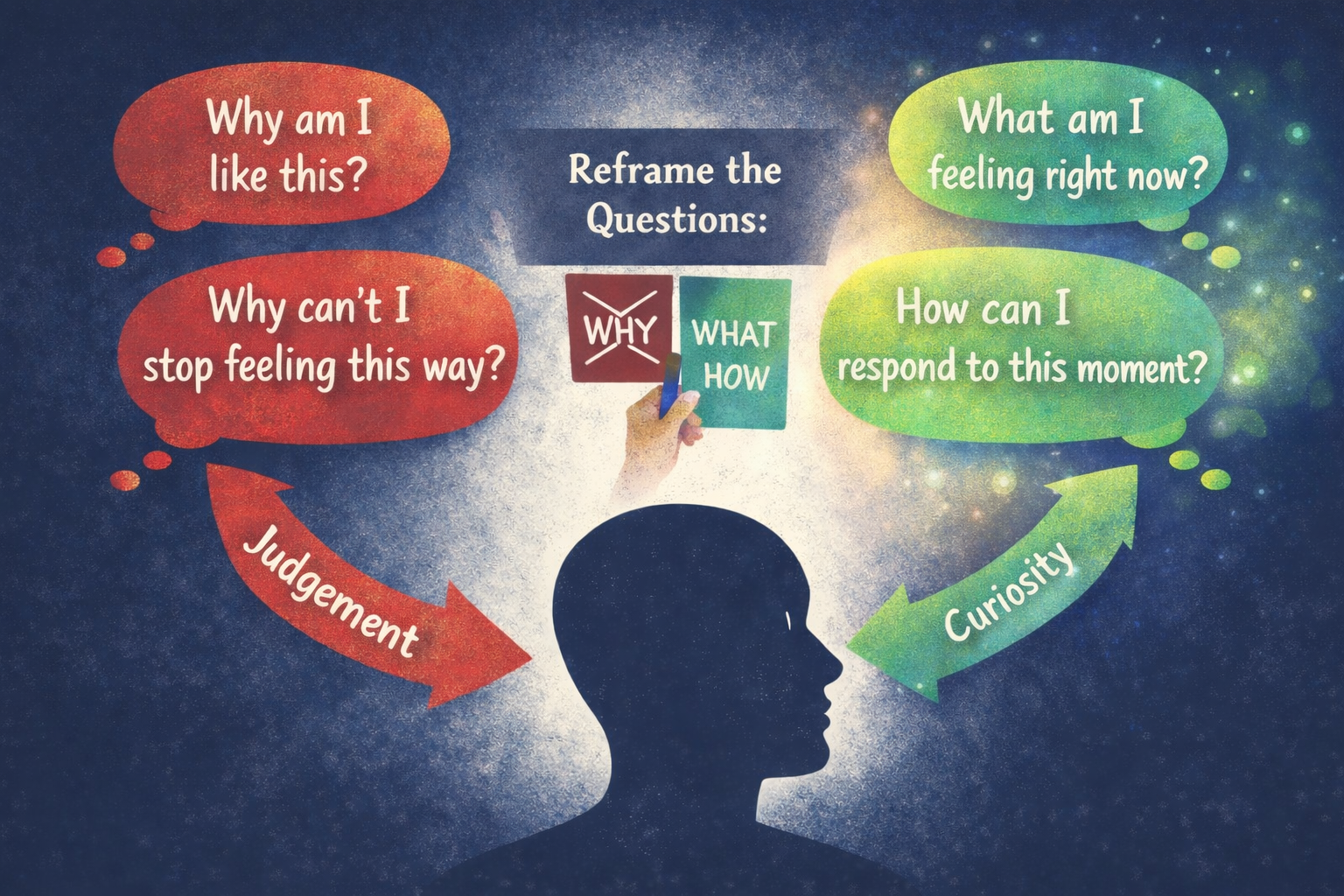
This small change moves the mind from judgement to curiosity, and from analysis to response.
Instead of interrogating yourself, you begin checking in with yourself.
“What Am I Experiencing Right Now?”
When anxiety appears, try asking:
“What am I experiencing right now?”
This question helps bring attention back to the present moment. You might notice things like:
Tension in your chest
Racing or repetitive thoughts
A sense of dread or unease
Restlessness in your body
Shallow breathing
Simply observing these sensations can create a small amount of space between you and the anxious thought.
That space is often where calm begins to return.
“How Can I Respond to This Moment?”
After noticing what you’re experiencing, the next helpful question becomes:
“How can I respond to this moment?”
This shifts your role. Instead of being the person judged by the thought, you become the person responding to the experience. Helpful responses might include:
Taking slow, steady breaths
Grounding yourself by noticing your surroundings
Writing the worry down rather than replaying it mentally
Postponing the worry until a designated “worry time”
Stepping outside for fresh air
These actions may seem small, but they help interrupt the cycle of rumination. It can offer a sense of control and choice back to you; by leaning into the negative thought and seeing it for what it is:
just a thought, not a fact!
How to Stop Negative Self-Talk
Learning how to stop negative self-talk doesn’t mean forcing positive thoughts or pretending difficult emotions don’t exist. Instead, it means:
changing the tone of your inner dialogue.
Imagine a friend came to you feeling anxious and overwhelmed.
You probably wouldn’t respond with:
“Why are you like this?”
You would be far more likely to say:
“That sounds really difficult. What might help right now?”
Developing self-compassion means learning to offer that same patience and understanding to yourself.
Changing Self-Criticism Into Self-Compassion
The questions we ask ourselves shape how we experience our emotions.
When our internal dialogue is dominated by self-judgement, anxiety tends to grow stronger.
But when we shift toward curiosity and compassion, something different happens.
Instead of asking:
“Why is this happening to me?”
We begin asking:
“What am I feeling right now?”
and
“How can I support myself while this feeling passes?”
This shift may seem small, but psychologically it can be powerful.
Over time, the inner voice that once criticised you can begin to sound more like a guide; helping you navigate difficult moments with patience rather than blame.
A Gentle Reminder
Anxious thoughts are temporary mental events, not permanent truths about who you are.
Learning to notice them, respond to them with curiosity, and treat yourself with patience can gradually soften the cycle of self-judgement.
You don’t need to win every battle with your thoughts.
Sometimes the most helpful step is simply asking a different question, and stepping out of the
Why Loop!
If you recognise yourself in these patterns and would like support in changing your inner dialogue, you’re very welcome to get in touch to arrange a consultation.
